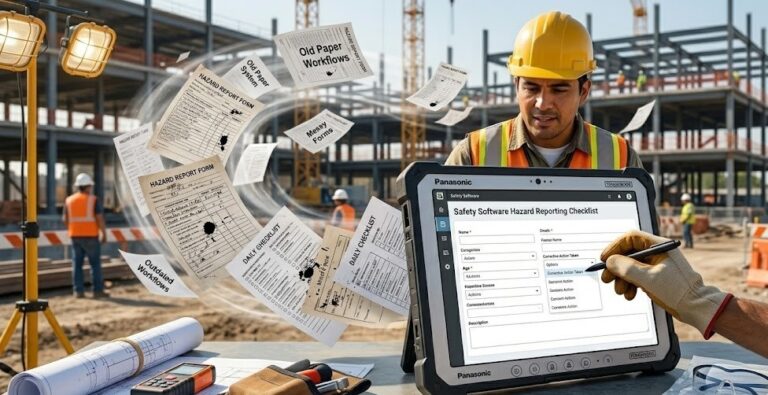
Why enterprise construction companies are moving away from paper safety systems
In large construction environments, paper based safety reporting is no longer practical. It might work for small sites, but at enterprise scale, it creates serious operational gaps. When a company manages multiple projects across regions, hundreds of subcontractors and thousands of workers, paper forms become slow, inconsistent, and difficult to track.
Hazard reports are delayed, safety inspections are missed, and compliance records become fragmented across job sites. This creates visibility problems for leadership teams who need real time insight into site safety conditions.
In enterprise construction, safety is not just a field activity. It is a governance function tied to compliance, risk management, and project delivery. When information is trapped in paper logs or disconnected spreadsheets, decision-making slows down and risk increases.
This is why large construction companies are transitioning toward digital safety reporting platforms that centralize hazard reporting, inspections, and compliance tracking across all sites.
The limitations of traditional construction safety workflows
Traditional safety workflows rely heavily on manual processes. A worker identifies a hazard, fills out a paper form, submits it to a supervisor, and waits for it to be processed. In a single site environment, this is already slow. Across enterprise operations, it becomes unmanageable.
Common issues include:
- Lost or incomplete safety reports
- Delayed hazard escalation
- Inconsistent reporting formats
- Difficulty tracking corrective actions
- Limited visibility across multiple sites
These issues directly affect construction site management and increase the risk of non-compliance.
Many companies try to solve this with basic software tools, but standard systems often fail to handle enterprise complexity. They lack integration with existing project systems and do not scale well across large contractor networks.
Digital safety reporting in modern construction environments
Digital transformation in construction safety focuses on replacing manual workflows with structured, real time systems. A construction safety app allows field teams to report hazards instantly using mobile devices or tablets.
Instead of paper forms, workers can:
- Log safety incidents in real time
- Attach photos and location data
- Assign corrective actions instantly
- Submit inspection results digitally
This data flows directly into a centralized construction safety management system, giving supervisors and safety manager’s immediate visibility into site conditions.
Platforms such as HammerTech, Salus, and HCSS have accelerated adoption of digital workflows. However, enterprise organizations often require more flexibility than standard platforms can provide, especially when integrating with internal systems.
Job hazard assessment and proactive risk control
A critical part of construction safety is identifying risks before work begins. A job hazard assessment app helps teams evaluate risks in a structured and consistent way before starting tasks.
In enterprise environments, this process is often mandatory before issuing work permits or allowing access to high-risk areas. Digital systems ensure that hazard assessments are completed, reviewed, and approved before work begins.
This improves accountability and reduces unsafe work practices. It also creates a digital record of risk assessments that can be used for audits and compliance reporting.
Over time, organizations can analyze hazard assessment data to identify recurring risks across projects. This supports better planning and stronger construction risk management software capabilities.
Building enterprise scale construction safety systems
Large construction organizations require more than simple reporting tools. They need integrated systems that support complex workflows across multiple regions, contractors, and regulatory environments.
A construction safety management software platform at enterprise level must handle:
- Multi site operations
- Hierarchical approval workflows
- Contractor safety management
- Regional compliance requirements
- Centralized reporting and analytics
Without this level of structure, safety data becomes fragmented and difficult to use for decision-making.
Enterprise systems also need to integrate with project management tools, workforce systems, and scheduling platforms. This ensures that safety is connected to operational planning, not treated as a separate function.
Custom software for enterprise safety operations
In large construction enterprises, off the shelf tools often reach their limits quickly. This is where custom safety management software becomes important.
Custom systems are designed around how the organization actually operates. Instead of adapting workflows to a tool, the software is built to match internal processes, compliance structures, and reporting requirements.
A custom approach allows organizations to:
- Design multi layer approval workflows
- Integrate with ERP and project systems
- Standardize safety processes across regions
- Centralize data across all job sites
- Build custom compliance dashboards
This level of flexibility is especially important for global construction firms and infrastructure companies managing complex portfolios of projects.
Real time safety tracking across enterprise operations
Visibility is one of the biggest challenges in construction safety. Without real time data, leadership teams are forced to rely on delayed reports and manual updates.
A safety tracking software system solves this by providing live visibility into site conditions across all projects.
Enterprise dashboards can show:
- Active safety incidents
- Open corrective actions
- Inspection completion status
- High risk site alerts
- Contractor compliance performance
This allows decision makers to respond quickly to emerging risks instead of reacting after incidents occur.
Mobile based site safety apps also allow field workers to contribute data instantly, ensuring that information is always up to date.
Construction compliance and regulatory management
Compliance is a major responsibility in construction operations. Regulations vary by region, project type, and governing authority. Managing this manually across multiple sites is extremely difficult.
A construction compliance software system centralizes compliance tracking and ensures that all safety activities are properly documented.
This includes:
- Safety inspections
- Incident reporting
- Worker certifications
- Training records
- Audit documentation
With digital systems, companies can generate compliance reports instantly instead of manually collecting documents from multiple sites.
This significantly reduces audit preparation time and improves regulatory readiness.
Cloud based safety systems for large construction companies
Enterprise construction companies increasingly rely on cloud based systems to manage safety operations across distributed projects.
A cloud based construction safety management system software provides:
- Centralized access to safety data
- Real time updates across all sites
- Scalable infrastructure for large operations
- Secure data storage and access control
Cloud systems also make it easier to onboard new projects and teams without deploying new infrastructure.
This is especially important for companies operating across multiple countries or managing large infrastructure programs.
Safety training and workforce readiness
Safety performance depends heavily on training and preparedness. Digital systems help ensure that workers are properly trained before entering job sites.
A safety training software for construction platform tracks:
- Training completion status
- Certification validity
- Role based safety requirements
- Site induction records
Some organizations also use construction induction software to ensure that new workers understand site rules before starting work.
This improves safety culture and reduces preventable incidents caused by lack of training or awareness.
Construction safety analytics and continuous improvement
Digital safety systems generate large volumes of data that can be used to improve safety performance over time.
With construction safety reporting software, organizations can analyze:
- Incident trends across sites
- Common hazard types
- Contractor performance
- High risk project areas
This helps company’s move from reactive safety management to proactive risk prevention.
Over time, this data becomes a strategic asset that supports better planning, design, and operational decisions.
Business impact of digital safety transformation
For enterprise construction companies, digital safety transformation is not just a compliance upgrade. It has direct business value.
Benefits include:
- Reduced incident rates
- Lower insurance and liability costs
- Improved project delivery timelines
- Better contractor accountability
- Stronger regulatory compliance
More importantly, it improves predictability across large-scale projects. When safety risks are managed effectively, projects experience fewer delays and disruptions.
Conclusion
Enterprise construction operations require more than paper based workflows or basic digital tools. They need structured, scalable, and integrated systems that connect safety with broader construction operations.
By adopting digital safety reporting platforms, job hazard assessment tools, and integrated safety management systems, large construction companies can improve visibility, reduce risk, and strengthen compliance across all projects.
Whether through advanced platforms or tailored system design, the goal is the same. Create a unified safety ecosystem that supports real time decision making and enterprise scale operations.
FAQs
Because paper systems are slow, hard to track, and do not scale across multiple sites or large enterprise operations.
It is a digital platform used to manage safety reporting, inspections, compliance, and incident tracking across construction sites.
It enables real time reporting of hazards, faster response times, and centralized visibility across all job sites.
It is used to identify and document risks before work begins to ensure safer work conditions and compliance.
It allows companies to monitor incidents and risks instantly across all sites, improving response time and decision-making.