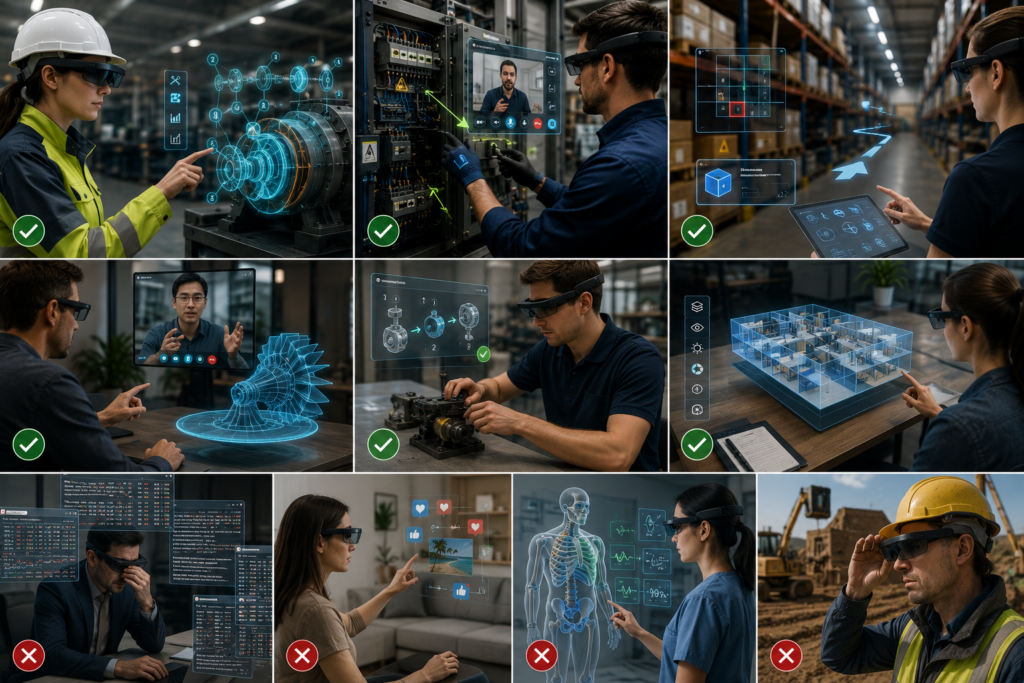
Augmented reality has moved from consumer novelty to operational tool in several enterprise contexts. Field technicians using AR overlays to see equipment schematics while working on machinery. Training programs that overlay instructions on real-world tasks. Quality control systems that highlight defects on a physical product in real time. Warehouse picking systems that guide workers with visual overlays.
But AR also has a history of ambitious enterprise pilots that never scaled beyond proof of concept. Understanding where it creates genuine operational value and where it does not helps organizations make better decisions before investing in development.
What Enterprise AR Actually Looks Like in Practice
Enterprise AR is not the consumer AR of phone camera filters. It is purpose-built software that overlays digital information onto the physical world through a device, typically a tablet, smart glasses, or a rugged handheld device, in a way that is useful to someone performing a specific task.
The information overlaid can be instructions, measurements, schematics, status indicators, defect markers, navigation guidance, or any other data that helps the user do their job better in the physical environment they are working in.
Where Enterprise AR Creates Genuine Operational Value
Field Service and Maintenance
Technicians servicing complex equipment benefit from AR overlays that display component schematics, maintenance procedures, and real-time sensor data while their hands remain free to work. In industrial and manufacturing environments where equipment complexity is high and experienced technicians are scarce, AR-assisted service reduces error rates and training time.
Quality Control and Inspection
AR systems connected to quality management data can highlight defects, out-of-tolerance measurements, and inspection checkpoints on physical products and equipment in real time. For inspection-intensive industries, this creates a direct connection between the digital quality record and the physical inspection process.
Training and Skills Transfer
AR training overlays that guide workers through complex procedures on real equipment accelerate skills transfer significantly compared to video or document-based training. New technicians can perform complex procedures with AR guidance before they have fully internalized the steps, which reduces errors during the learning period.
Warehouse and Logistics Operations
Pick-by-vision systems using AR glasses have demonstrated consistent accuracy improvements in warehouse environments. Visual guidance for picking routes, item identification, and placement verification reduces training time and error rates in logistics operations where speed and accuracy are both critical.
Where Enterprise AR Consistently Underdelivers
Pilots that cannot scale. AR pilots often work well in controlled conditions with enthusiastic users and dedicated support. When they reach full deployment across a workforce with varying tech comfort levels, inconsistent device quality, and the realities of production environments, they frequently fail to deliver on their promise.
Device dependency. Enterprise AR requires devices that employees will actually use in the conditions where the work happens. Construction sites, manufacturing floors, and outdoor field environments are harsh on hardware. Device management, battery life, and ruggedization are operational challenges that pilots often underestimate.
Content creation cost. AR experiences require 3D models, schematics, and digital content that must be created, maintained, and updated as equipment and procedures change. The content creation cost is often significantly higher than the software development cost and is ongoing.
Integrating AR with Existing Enterprise Systems
AR applications that are not connected to the organization’s operational systems provide limited value. An AR inspection tool that does not write back to the quality management system creates a parallel data record that nobody trusts. An AR field service tool that does not pull from the maintenance management system shows technicians outdated information.
The API integration work that connects AR applications to existing systems is what transforms them from interesting demonstrations into operational tools.
FAQs
Enterprise augmented reality overlays digital information onto the physical world through a device. As a result, workers can perform specific tasks more accurately and efficiently. Unlike consumer AR, enterprise AR supports defined operational workflows and typically integrates with existing enterprise systems.
AR often delivers consistent returns in field service and maintenance. In addition, manufacturing quality control can benefit. Similarly, warehouse operations, logistics, and technical training can generate strong returns. In each case, workers perform physical tasks and benefit from seeing relevant digital information directly in their field of view.
Organizations often struggle to scale AR beyond pilot projects. They must also manage devices in harsh environments, maintain content, and integrate AR with existing enterprise systems. As a result, organizations that underestimate these demands often struggle to turn successful pilots into full deployments.
Yes, operational AR must integrate with existing systems to deliver real value rather than function as a demonstration. For example, AR inspection tools must send data to quality management systems. AR field service tools must retrieve information from maintenance management systems. Similarly, AR warehouse tools must connect with warehouse management systems. Ultimately, these integrations make AR useful in daily operations rather than merely interesting.
Smart glasses from providers like RealWear and Google, tablets with AR capabilities, and rugged handheld devices are the most common enterprise AR platforms. The right device depends on the specific use case, the environment where it will be used, and the organization’s device management capabilities.
Enterprise AR development costs vary significantly based on the complexity of the AR experience, the devices targeted, the integrations required, and the content creation requirements. Projects typically start at CA$50,000 for focused applications and scale significantly for comprehensive platforms with extensive content libraries.
AR overlays digital information onto the real world. VR replaces the real world with a simulated environment. Enterprise AR is most useful for tasks performed in the physical world where workers benefit from additional digital information. Enterprise VR is most useful for simulation-based training where the actual environment is unavailable, dangerous, or expensive to access.