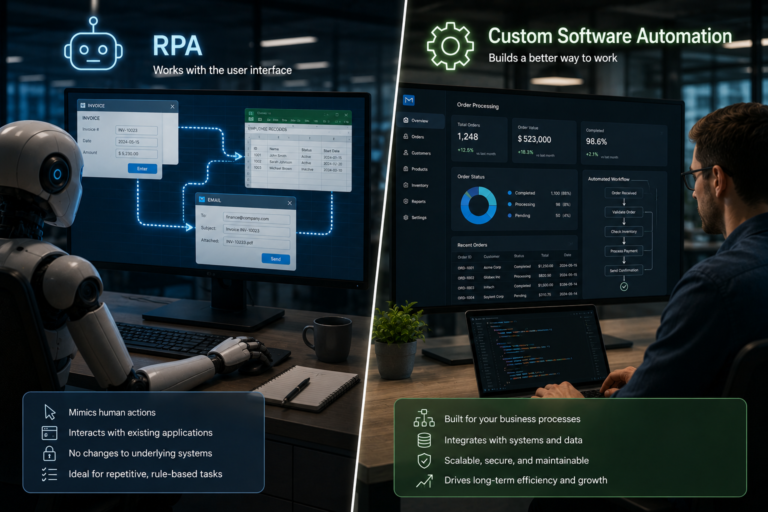
Robotic process automation and custom software automation are both used to eliminate manual work from business processes. They accomplish this in fundamentally different ways, with different strengths, different failure modes, and different long-term cost profiles. Understanding the distinction helps organizations make better decisions about which approach fits which problem.
What RPA Does
RPA bots interact with software applications through the interface layer, the same way a human user does. They open applications, read and enter data, click buttons, copy information between systems, and trigger workflows. The bot is essentially a software robot performing the same actions a human would perform, but faster and without breaks.
This approach works because it does not require any changes to the underlying applications. The bot interacts with the existing interface without needing API access or system modifications. This makes RPA deployable quickly on top of existing systems.
What Custom Software Automation Does
Custom software automation builds the automation logic into the application or integration layer. Instead of a bot mimicking a user clicking through an interface, the automation is a direct connection between systems, a rule embedded in a workflow engine, or a trigger built into the business logic of the application.
Custom automation interacts with data and logic directly, not through visual interfaces. It is more stable because it does not depend on the interface remaining unchanged. It handles exceptions by design rather than by workaround. And it is significantly easier to maintain and evolve.
The Key Differences in Practice
Stability
RPA bots break when interfaces change. Application updates, screen layout changes, or new fields in a form can all cause a bot to fail. Custom automation built at the integration layer does not have this dependency and is significantly more stable over time.
Exception Handling
Real business processes have exceptions. RPA handles exceptions poorly and typically requires human intervention when inputs fall outside the expected pattern. Custom automation can be designed to handle known exception types automatically and route genuine exceptions to the right person with the right context.
Maintenance Cost
RPA bot maintenance is an ongoing cost that grows with the number of bots and the frequency of application changes. Custom automation maintenance is lower because the automation is integrated into systems that change less frequently and that the development team understands deeply.
Speed to Deploy
RPA can be deployed faster because it does not require system modifications. For a quick fix to a specific manual process where speed matters more than long-term elegance, RPA can be the right answer even knowing its limitations.
Which Approach Fits Which Problem
Use RPA when you need to automate a specific process quickly, the underlying systems do not expose APIs, and you understand that bot maintenance is a cost you are accepting. Use custom workflow automation when you need automation that is stable, handles exceptions reliably, connects systems that do have API capability, or needs to evolve as the business evolves.
For most enterprise organizations, the right answer is a combination: RPA for specific legacy system interactions where custom integration is not feasible, and API integration services for the core connections between modern systems.
According to McKinsey’s 2024 automation research, organizations that combine RPA with intelligent automation and custom integration see 2 to 3 times the productivity improvement of those using RPA alone.
FAQs
RPA stands for robotic process automation. It refers to software that automates repetitive tasks by mimicking human interactions with digital systems through their visual interfaces.
No. RPA follows rules and cannot learn or adapt. It does what it is programmed to do with inputs it recognizes. AI systems learn from data and can make decisions in situations they have not explicitly been programmed for. Some modern automation platforms combine RPA with AI components, but they are distinct capabilities.
High-volume, rule-based processes with consistent inputs where the underlying systems do not support direct API integration. Invoice processing, data migration between legacy systems, report generation from multiple sources, and routine compliance documentation are common examples.
Custom software automation builds automation logic directly into applications or integration layers rather than overlaying bots on top of existing interfaces. It connects systems through APIs, embeds business rules in workflow engines, and builds triggers into application logic. It is more stable, more maintainable, and better at handling exceptions than RPA.
The key questions are: Do the systems involved support API integration? How stable are the underlying interfaces? How complex is the exception handling required? What is the acceptable ongoing maintenance cost? If APIs are available and the process has significant exceptions, custom automation is almost always preferable.
Yes, and in most enterprise environments they do. RPA handles specific legacy system interactions where API integration is not feasible. Custom automation handles core system connections and processes that require reliability and exception handling. The two approaches serve different needs and can operate alongside each other.
When a bot breaks, the process it was automating stops. A human has to either complete the process manually or fix the bot before the automation can resume. In high-volume environments, bot failures can create significant backlogs. This is the primary operational risk of relying heavily on RPA for mission-critical processes.