Running software across multiple locations is not the same as running it in one place. The operational, technical, and organizational complexity of managing software across multiple sites, cities, or countries introduces challenges that single-location organizations do not face and that generic software platforms consistently underestimate.
This article covers what changes when a business scales across locations, where software for multi-location organizations typically breaks down, and what custom software enables that generic platforms cannot.
What Changes When You Operate Across Multiple Locations
Data Sovereignty and Access Control
Multi-location businesses need to control who sees what data. A regional manager should see data for their region but not others. Location managers should see their own site data and appropriate aggregates. Corporate leadership needs consolidated views across all locations. Generic platforms handle this with role-based access control that often does not match the specific organizational hierarchy of a particular business.
In Canada, multi-location businesses operating across provinces may also have data residency considerations, particularly in healthcare and financial services, where data generated in one province has specific requirements about where it can be stored and who can access it.
Standardization vs Local Variation
Multi-location businesses face a consistent tension between standardizing processes across locations for consistency and efficiency and allowing local variation to accommodate differences in regulations, market conditions, or operational realities. Generic platforms force a choice. Custom software can encode standardization where it is required and allow variation where it is appropriate.
Consolidated Reporting
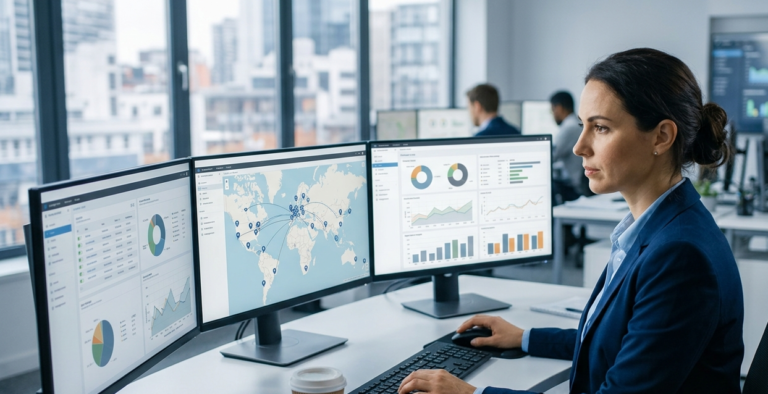
Reporting that requires manual consolidation from multiple location-level systems is one of the most common pain points for multi-location organizations. When each location produces its own reports in its own format, creating a consolidated view requires manual assembly that introduces delay and inconsistency. Custom software that consolidates data automatically across locations gives leadership real-time visibility rather than delayed, manually assembled summaries.
Process Compliance
Ensuring that all locations follow required processes, document required activities, and meet required standards is an operational challenge that scales with the number of locations. Custom software that embeds process requirements into operational workflows and reports compliance metrics automatically reduces the audit overhead and the risk of non-compliance across a distributed operation.
Industries Where Multi-Location Software Complexity Is Most Pronounced
Construction and infrastructure: Managing safety documentation, subcontractor compliance, and project reporting across multiple active sites simultaneously.
Manufacturing: Coordinating production, quality, and supply chain data across multiple facilities with different equipment, shift structures, and production processes.
Logistics and distribution: Managing carrier relationships, shipment tracking, and compliance documentation across multiple distribution centres.
Pharmaceutical and healthcare: Maintaining regulatory compliance, batch traceability, and quality documentation standards across multiple manufacturing or dispensing sites.
What Custom Software Enables for Multi-Location Operations
Centralized data with location-level access controls that match the actual organizational hierarchy. Standardized process workflows with configurable local variations where the business requires them. Consolidated real-time reporting across all locations without manual assembly. Automated compliance tracking that identifies gaps across locations before they become audit findings.
System integrations that connect location-level operational systems to corporate ERP, financial, and reporting platforms automatically, eliminating the manual data aggregation that multi-location operations typically depend on.
Frequently Asked Questions
Data access control that matches the organizational hierarchy across locations. Standardization of processes while allowing necessary local variation. Consolidated reporting without manual data assembly. Compliance monitoring across locations simultaneously. Integration between location-level operational systems and corporate platforms.
Generic platforms handle the common multi-location case adequately. Organizations with specific organizational hierarchies, complex reporting requirements, unusual local variation needs, or strict data residency requirements typically find that generic platforms require significant workarounds that accumulate into real operational overhead.
By connecting location-level operational systems to a centralized data layer that produces consolidated reports automatically rather than requiring manual data extraction and assembly from each location. Leaders see current consolidated data rather than reports that are days or weeks old and require manual reconciliation.
Typically, integration between location-level operational systems and corporate ERP, financial, and reporting platforms. The complexity depends on how many systems exist at the location level, whether those systems are standardized across locations or vary, and what the corporate systems are.
Yes. This is one of the clearest advantages of custom software for Canadian multi-location organizations. Regulatory requirements that differ by province can be encoded into the system at the location level while maintaining consistent corporate processes and reporting standards.