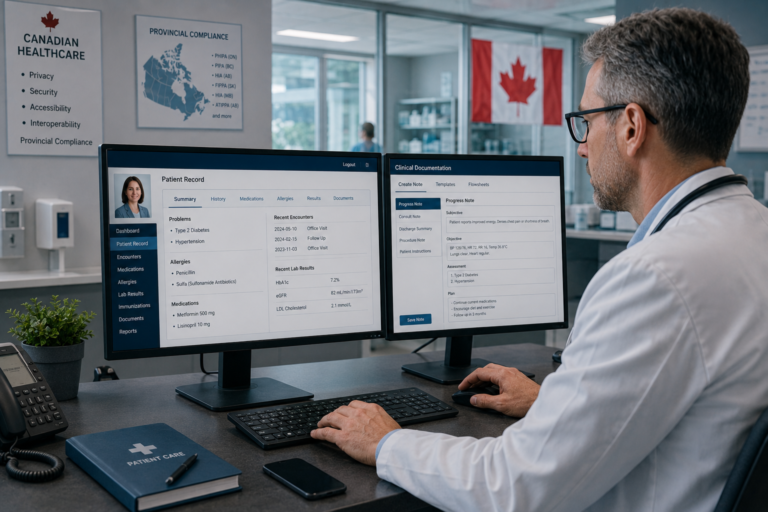
Electronic health record software is one of the most consequential technology investments a healthcare organization makes. The right system improves care coordination, reduces administrative burden, and creates the data foundation for better clinical decisions. The wrong one creates compliance exposure, operational inefficiency, and staff frustration that persists for years.
For Canadian healthcare organizations evaluating EHR options, the decision involves considerations that are specific to the Canadian regulatory environment, the provincial healthcare system structure, and the integration requirements of Canadian clinical workflows. This article covers what matters in that decision.
What EHR Software Actually Does
An electronic health record system is the digital record of a patient’s health history across encounters, providers, and time. At its core, it captures clinical documentation, diagnostic information, medication records, and care plans. In practice, modern EHR systems do significantly more.
Scheduling and patient flow management, billing and claims processing, lab and imaging order management, referral coordination, population health reporting, and increasingly, decision support and analytics are all components of comprehensive EHR platforms.
The challenge for healthcare organizations is that different types of facilities have different needs. A hospital network has fundamentally different EHR requirements than a community health centre, a specialist clinic, or a long-term care facility. Generic platforms make compromises. Custom or highly configured systems fit specific workflows.
The Canadian Healthcare Context
Canadian healthcare is administered provincially, which creates significant variation in EHR requirements across provinces. Each province has its own health data privacy legislation alongside federal requirements. Provincial health information networks have their own integration standards. Billing and claims processing requirements vary by province.
For healthcare organizations operating in Ontario, the Personal Health Information Protection Act sets the baseline for how PHI must be handled, stored, and transmitted. British Columbia has its own legislation. Quebec operates under different requirements again. EHR systems deployed in Canada must comply with the applicable provincial framework in addition to any relevant federal standards.
Custom healthcare software development that addresses these provincial variations at the architecture level is significantly more effective than generic platforms that treat compliance as a configuration option. Building compliance into the system design rather than adding it later is the approach that holds up under audit.
Off-the-Shelf EHR vs Custom Healthcare Software
When Off-the-Shelf EHR Makes Sense
Large hospital networks that deploy comprehensive EHR systems across multiple facilities often benefit from the broad functionality of major platforms such as Epic, Cerner, and MEDITECH. In addition, these platforms draw on decades of development, extensive implementation partner networks, and large integration libraries.
The trade-off is cost, implementation complexity, and the need to configure extensively to fit workflows that differ from the platform’s assumptions. Major EHR implementations at large hospital networks routinely cost tens of millions of dollars and take years to complete.
When Custom Development Makes More Sense
Specialized facilities, community health centres, and organizations with specific workflow requirements that major platforms do not address well are strong candidates for custom healthcare software development. The upfront cost is higher than a basic platform license but lower than a major EHR implementation, and the result fits the actual workflow rather than requiring the organization to adapt to the platform.
Custom development also makes sense when integration with existing systems is the primary challenge. A healthcare organization that has existing operational systems and needs an EHR that connects cleanly to them often finds that custom integration work is more cost-effective than replacing all existing systems with a new platform.
Integration Is Where EHR Projects Succeed or Fail
Healthcare data does not stay in one system. Lab results come from laboratory information systems. Imaging comes from picture archiving and communication systems. Billing flows to claims management platforms. Patient scheduling connects to external referral networks. API integration services that connect these systems cleanly are what determines whether an EHR implementation delivers its promised value or creates new silos alongside the old ones.
The HL7 FHIR standard has become the interoperability foundation for modern healthcare systems in Canada and internationally. EHR systems that support FHIR-compliant APIs can share data with other compliant systems without custom integration work for each connection. This is increasingly a baseline requirement for new healthcare software deployments.
FAQs
EHR software is the digital system that stores and manages patient health records across encounters, providers, and time. It captures clinical documentation, medications, diagnoses, lab results, and care plans, and typically includes scheduling, billing, and reporting functionality.
An EMR is an electronic medical record that a single practice or facility uses. In contrast, an EHR allows multiple providers and care settings to share information. As a result, EHR systems support the continuity of care that modern healthcare requires. However, this distinction has become less important as most systems now support interoperability.
Canadian EHR compliance requirements vary by province. For example, Ontario healthcare organizations must comply with PHIPA, while organizations in British Columbia operate under PIPA and FIPPA. In every province, healthcare organizations must store, access, and transmit personal health information according to applicable provincial legislation. In some contexts, federal privacy legislation also applies. Therefore, Canadian organizations developing custom EHR systems should incorporate provincial compliance requirements into the system architecture from the beginning.
HL7 developed Fast Healthcare Interoperability Resources, or FHIR, to standardize how healthcare systems structure and share data. As a result, EHR systems that support FHIR can exchange information with other compliant systems through standard APIs. Therefore, FHIR provides the foundation for modern healthcare interoperability and increasingly supports connections to provincial health networks.
Custom EHR development for a specialized healthcare facility or community health centre typically takes between 6 and 18 months depending on scope, integration requirements, and compliance validation. This is comparable to the implementation timeline for a configured off-the-shelf platform and often produces a better fit for specific workflows.
Clinical workflow fit, compliance with applicable provincial legislation, integration capability with existing systems and provincial health networks, total cost of ownership over a five to ten year horizon, and the vendor’s experience with Canadian healthcare specifically. Generic demonstrations that do not address provincial requirements are a red flag.
Yes. Custom software built for specific clinical functions, patient portals, analytics, or specialized workflows can integrate with existing EHR systems through FHIR APIs or custom integration layers. This allows healthcare organizations to extend their existing platform rather than replacing it when the platform handles core functions well.