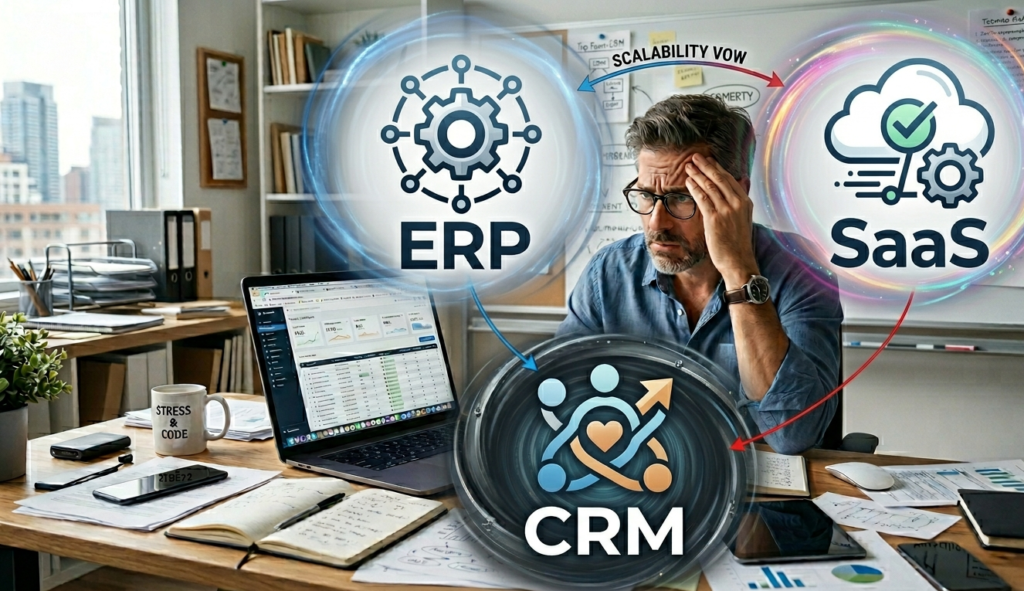
In 2026, Canadian businesses face increasing pressure to streamline operations, improve customer experiences, and adopt scalable technology solutions. ERP, SaaS, CRM, and custom software development Canada are no longer optional, they are essential tools for growth. This guide explains how these technologies work, their benefits, costs, and how to choose the right solutions for medium and large enterprises.
Understanding SaaS and Its Importance for Businesses
What is SaaS?
SaaS, or Software as a Service, is software delivered online via subscription. Unlike traditional software, it requires no local installation or maintenance. SaaS companies develop, host, and manage these solutions, ensuring users always have access to updated features.
Think of SaaS like renting a fully furnished office. You don’t worry about upkeep, furniture, or utilities; you just focus on work. Popular examples include Microsoft 365, Salesforce, HubSpot, and Shopify.
Key Features of SaaS
SaaS offers several advantages for Canadian businesses:
- Accessibility: Work from anywhere on web or mobile platforms.
- Subscription Pricing: Predictable costs without large upfront investments.
- Automatic Updates: Security patches and feature upgrades handled by the provider.
- Scalability: Add or remove users as your business grows.
- Security and Compliance: Cloud providers follow Canadian data privacy laws.
- Integration Capabilities: Easily connects with ERP and CRM systems.
- Analytics and Reporting: Dashboards for tracking performance and customer insights.
Integration with Existing Systems
To get maximum value, SaaS solutions often need to integrate with ERP, CRM, or legacy systems. Best practices include:
- Assessing your current systems and workflows.
- Selecting SaaS platforms that support APIs or middleware connectors.
- Mapping data flows between systems for consistency.
- Using tools like Zapier or MuleSoft for integration.
- Testing the system thoroughly before going live.
- Monitoring updates to ensure ongoing compatibility.
Proper integration ensures SaaS enhances efficiency instead of creating operational silos.
ERP: Streamlining Operations Across the Organization
What is ERP?
ERP, or Enterprise Resource Planning, integrates multiple business functions into a single platform. This includes finance, HR, supply chain, inventory, and operations. ERP ensures departments work with consistent data, improving decision-making and efficiency.
Benefits of ERP
- Centralized Data: Reduces errors caused by disconnected systems.
- Operational Efficiency: Automates workflows across departments.
- Business Intelligence: Provides real-time dashboards for informed decisions.
- Compliance and Reporting: Simplifies financial reporting and regulatory compliance.
Challenges of ERP Implementation
ERP is powerful but complex. Common challenges include:
- High upfront costs for licenses, customization, and consulting.
- Long implementation timelines requiring careful planning.
- Employee resistance and the need for change management.
- Data migration difficulties from legacy systems.
- Over-customization, which can complicate updates and maintenance.
Partnering with an experienced software development company Canada ensures smoother deployment and helps avoid costly mistakes.
CRM: Enhancing Customer Relationships and Sales
What is CRM?
CRM, or Customer Relationship Management, tracks interactions between your business and customers. It helps manage sales pipelines, marketing campaigns, and customer support, improving revenue and loyalty.
Key Benefits
- Sales Management: Tracks prospects, leads, and conversions.
- Customer Support Automation: Ticketing systems improve service quality.
- Marketing Automation: Personalized campaigns improve engagement and retention.
- Data-Driven Insights: Analytics reveal trends to improve decision-making.
Top CRM Tools for Canadian Businesses
- Salesforce: Highly customizable and scalable for large enterprises.
- HubSpot CRM: User-friendly, with integrated marketing and service tools.
- Zoho CRM: Affordable and flexible for mid-sized companies.
- Microsoft Dynamics 365: Strong ERP-CRM integration.
- Pipedrive: Sales pipeline-focused for fast-growing businesses.
Selecting the right CRM depends on company size, workflows, and integration needs.
Custom Software Development in Canada
Some businesses require solutions beyond off-the-shelf software. A custom application development company creates software tailored to your workflows, integrating ERP, CRM, and SaaS as needed.
Costs of Custom Software Development
- Development Rates: CAD 75–200 per hour depending on expertise.
- UI/UX Design: CAD 5,000–25,000 for interface and user experience.
- Testing & Quality Assurance: Typically, 10–20% of total project cost.
- Maintenance & Support: About 15–20% per year for updates and bug fixes.
- Integration Costs: Additional fees may apply for ERP, CRM, or SaaS integration.
Custom solutions provide a competitive edge, streamline processes, and ensure technology aligns with business goals. Companies like Konverge have successfully delivered tailored ERP, CRM, and SaaS solutions.
Cloud vs On-Premise Solutions
Businesses must choose between cloud-based (SaaS) and on-premise deployments:
- Cloud-Based Solutions: Accessible anywhere, lower upfront costs, scalable, managed by the provider.
- On-Premise Solutions: Full control, higher security, higher initial investment, requires internal IT management.
Many medium and large Canadian enterprises benefit from hybrid solutions that combine cloud flexibility with on-premise control where necessary.
Industry-Specific Software Applications
Different industries have unique needs:
- Finance: Compliance and risk management.
- Healthcare: Patient data management and telehealth integration.
- Retail: Inventory, POS, and e-commerce solutions.
- Manufacturing: Supply chain optimization and real-time production monitoring.
Custom software ensures solutions align with industry-specific workflows.
Latest Trends in 2026
- AI-Powered ERP and CRM: Automates decision-making and generates insights.
- Low-Code and No-Code Platforms: Enables faster deployment and reduces development bottlenecks.
- Integration & Automation: Seamless connectivity across SaaS, ERP, and CRM improves operational efficiency.
FAQs About SaaS, ERP, and CRM
- What is SaaS? Software delivered online via subscription.
- What is a SaaS company? A company that develops, hosts, and manages online software.
- What are the benefits of ERP? Centralized data, operational efficiency, compliance, and analytics.
- How does CRM help businesses? Tracks sales, automates support, and provides insights for better decision-making.
- What is the cost of custom software development? Typically CAD 50,000–250,000 for medium businesses; enterprise solutions can exceed CAD 500,000.
- How to integrate SaaS with existing systems? Assess workflows, use API or middleware tools, map data flows, test thoroughly, and monitor updates.
Conclusion: Future-Proofing Your Business
Investing in custom software development Canada, SaaS, ERP, and CRM solutions is essential for medium and large Canadian businesses. A reliable software development company Canada can integrate these solutions, streamline workflows, and provide a scalable platform for growth. Companies like Konverge demonstrate how tailored software can transform operations and drive competitive advantage.
FAQs
SaaS (Software as a Service) is a cloud-based delivery model where software is accessed online through a subscription. It eliminates the need for installation, maintenance, and infrastructure management. For Canadian businesses, SaaS is crucial because it reduces upfront costs, enables remote work, and ensures compliance with evolving data regulations while keeping systems updated automatically.
ERP systems centralize data across departments like finance, HR, and supply chain, creating a single source of truth. This reduces duplication, minimizes errors, and automates workflows. As a result, businesses can make faster, data-driven decisions while improving productivity and reducing operational costs.
CRM systems help businesses manage customer interactions, track sales pipelines, and automate marketing and support. By providing detailed insights into customer behavior, CRM tools improve customer retention, enhance personalization, and ultimately drive revenue growth.
The cost varies depending on complexity and scope. Medium-sized projects typically range from CAD 50,000 to CAD 250,000, while enterprise-level solutions can exceed CAD 500,000. Factors like design, integrations, testing, and ongoing maintenance all influence the final cost.
Cloud solutions offer scalability, lower upfront costs, and remote accessibility, making them ideal for most modern businesses. On-premise systems provide greater control and security but require higher investment and in-house IT resources. Many Canadian enterprises opt for hybrid models to balance flexibility and control.