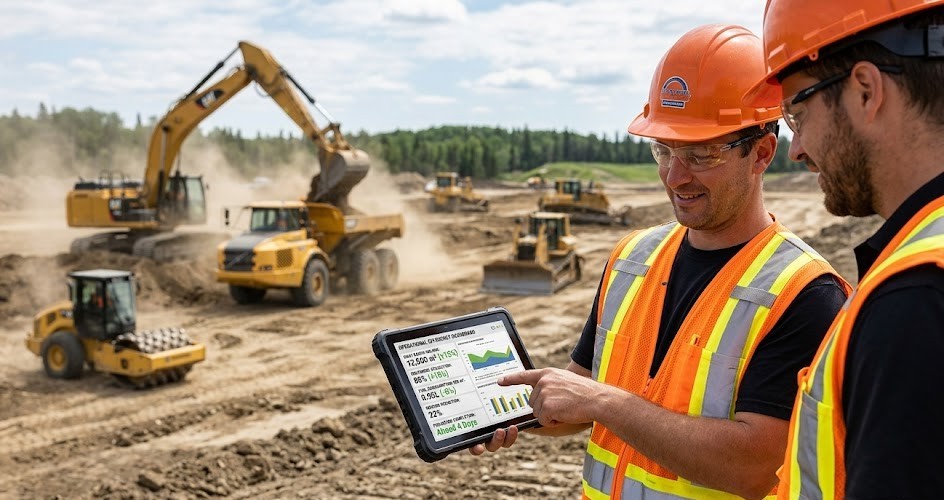
Why Earthworks Projects Struggle with Operational Inefficiency
Earthworks projects don’t usually fail because of lack of equipment or labor. They fail quietly through inefficiency that builds up day after day. A truck waits too long at a loading point, an excavator sits idle because the next task is not ready, or crews arrive on-site without synchronized timing. These issues feel small in isolation, but in heavy civil construction, they compound into massive cost overruns. This is the core problem that drives the need for construction ROI software and more advanced digital systems.
Most contractors still rely on fragmented tools or manual coordination to manage complex job sites. That means scheduling lives in one system, equipment logs in another, and job progress updates in spreadsheets or messaging apps. The result is simple: nobody sees the full picture. Without full visibility, inefficiency becomes invisible until it shows up in financial reports at the end of the month. By then, the damage is already done.
Earthworks operations are especially sensitive to timing because machines are expensive to run per hour. Even a 10 percent drop in utilization can significantly affect project margins. When operators are waiting for instructions or materials, that cost cannot be recovered. This is where earthworks software begins to change the equation by making inefficiency measurable instead of hidden.
The challenge is not that teams lack effort. It is that they lack synchronized information. When data flows slowly or unevenly across teams, decisions lag behind reality. Custom software is designed to close that gap by aligning field activity, machine usage, and project planning into a single system of truth.
The Hidden Cost of Poor Scheduling in Heavy Civil Construction
Scheduling in earthworks is often treated as a static plan rather than a living system. That approach creates one of the most expensive problems in construction: misalignment between planned work and actual site conditions. A schedule might look perfect in the office, but on-site reality changes hourly due to weather, equipment breakdowns, or material delays. Without dynamic updates, the gap between plan and execution widens quickly.
This is where heavy civil construction software makes a measurable difference. Instead of relying on fixed timelines, custom systems continuously adjust schedules based on real-time inputs. When a dump truck is delayed or a crew finishes early, the schedule updates instantly across all teams. That prevents cascading delays that typically come from outdated information.
Equipment Idle Time and Lost Productivity
Idle equipment is one of the most expensive hidden costs in earthworks. A dozer sitting idle for even one hour still generates fuel burn, operator cost, and opportunity loss. The problem is that most contractors do not track idle time accurately. It is buried inside broader operational reports.
With integrated equipment tracking systems, idle time becomes visible and actionable. Managers can immediately see where machines are waiting and why. That allows them to rebalance workloads or adjust sequencing before losses accumulate. Over time, this visibility alone can significantly improve construction project management ROI.
Poor scheduling also affects crew efficiency. When workers arrive before machinery is ready or materials are delayed, productive time is lost. Custom scheduling tools eliminate this disconnect by synchronizing all moving parts into one coordinated workflow.
Why Traditional Tools Fail to Measure Real ROI
Spreadsheets and generic project management tools were never designed for the complexity of earthworks. They can record data, but they cannot interpret it in real time. This creates a major blind spot in construction productivity tools because companies assume they are tracking efficiency when they are only recording activity.
Traditional tools fail in three critical areas. First, they do not integrate equipment, labor, and scheduling data into a single system. Second, they rely heavily on manual updates, which introduces delays and errors. Third, they cannot calculate real-time operational efficiency metrics such as utilization rates or cycle times.
This is why many companies invest in software but still struggle to prove ROI. Without proper system design, data remains fragmented. In contrast, construction industry apps built for earthworks combine field data with operational analytics, allowing managers to see exactly where time and money are being lost.
Another limitation is that traditional tools cannot simulate scenarios. For example, what happens to project cost if one excavator is reassigned? Alternatively, how does fuel usage change if haul routes are adjusted? Custom software can model these outcomes, helping managers make data-driven decisions instead of reactive ones.
How Custom Software Changes Earthworks Project Management
Custom software fundamentally changes how earthworks projects are managed by turning fragmented operations into a connected system. Instead of managing scheduling, equipment, labor, and reporting separately, everything flows through one integrated platform. This creates visibility that was previously impossible in traditional workflows.
The biggest shift is real-time decision-making. With construction site safety and tracking systems and operational dashboards combined, managers can respond to issues as they happen rather than after delays occur. That reduces downtime and improves coordination across teams.
Custom systems also allow automation of repetitive tasks. Reporting, equipment logs, and compliance documentation can be generated automatically. This reduces administrative workload and frees up supervisors to focus on field operations rather than paperwork.
Another major improvement is data consistency. When all teams use the same system, there is no confusion between versions of schedules or conflicting reports. This eliminates communication errors that often lead to costly mistakes in earthworks execution.
Most importantly, custom software aligns directly with business goals. Instead of adapting processes to fit generic tools, the software is built around how the contractor actually operates. This alignment is what makes construction project management ROI measurable and sustainable.
Turning Scheduling Chaos into Predictable Workflows
Earthworks scheduling often feels chaotic because so many variables change daily. Custom software introduces structure by transforming unpredictable workflows into adaptive systems. Instead of static plans, schedules become dynamic models that adjust automatically based on real-time conditions.
A key feature is dependency mapping. Every task is linked to the resources it depends on, whether that is equipment, labor, or material delivery. When one element changes, the system recalculates the entire workflow. This prevents the ripple effect that typically causes major delays in earthworks projects.
Real-Time Scheduling Adjustments in the Field
One of the most powerful improvements comes from field-level updates. Using mobile-connected construction company apps, supervisors can adjust schedules directly from the job site. If weather delays excavation or a machine breaks down, updates are pushed instantly to all stakeholders.
This eliminates the lag between field reality and office planning. It also ensures that all teams operate on the same version of the truth. Over time, this level of synchronization significantly improves productivity and reduces wasted effort.
Improving Equipment Utilization with Tracking Systems
Equipment utilization is one of the most direct indicators of profitability in earthworks. Custom equipment tracking systems provide real-time insights into how machines are being used, where they are idle, and how efficiently they are operating.
Without this visibility, contractors often assume machines are fully utilized when they are not. Studies in heavy civil operations frequently show that actual utilization rates are far lower than expected due to downtime, coordination gaps, and scheduling inefficiencies.
By tracking usage patterns, software identifies underperforming assets and operational bottlenecks. It also helps optimize fleet distribution across multiple job sites. This ensures that equipment is always positioned where it generates the highest return.
Integration with heavy civil construction software allows utilization data to feed directly into cost models. That means contractors can see exactly how machine performance impacts project profitability in real time.
Connecting Labor, Machines, and Jobsite Data in One System
One of the biggest inefficiencies in earthworks comes from disconnected systems. Labor is managed separately from machines, and jobsite reporting often lags behind actual operations. Custom software solves this by connecting everything into a single data environment.
When labor schedules, equipment logs, and jobsite updates are unified, coordination improves dramatically. Supervisors can see exactly which crews are available, which machines are active, and what tasks are ready to execute.
This integration also improves accountability. Every action is logged, which reduces miscommunication and ensures that responsibilities are clearly defined. Over time, this leads to smoother workflows and fewer operational conflicts.
Measuring Construction Project Management ROI Accurately
Accurate ROI measurement in earthworks requires more than cost comparison. It requires understanding how efficiency improvements translate into financial outcomes. Custom software enables this by linking operational metrics directly to project costs.
Key indicators include equipment utilization rates, cycle times, idle hours, fuel consumption, and labor productivity. When these metrics are tracked consistently, contractors can clearly see how software affects profitability.
Unlike traditional reporting methods, digital systems provide continuous ROI visibility rather than end-of-project analysis. This allows for ongoing optimization instead of retrospective evaluation.
Conclusion
Earthworks projects fail or succeed based on efficiency, not effort. The real cost driver is not visible labor or equipment expense, but the hidden waste created by poor coordination, delayed scheduling, and fragmented data systems. Custom software eliminates these inefficiencies by connecting every operational layer into a single, measurable system.
When scheduling becomes dynamic, equipment utilization becomes transparent, and jobsite data becomes real time, contractors gain something they rarely have in heavy civil construction: control over variability. That control is what turns operational improvements into measurable construction project management ROI.
FAQs
By tracking changes in equipment utilization, idle time reduction, scheduling accuracy, and labor productivity before and after implementation.
Equipment uptime, cycle time efficiency, fuel usage, labor utilization, and project delay reduction.
Yes, because it exposes idle time and inefficiencies that are otherwise hidden in manual reporting systems.
It reduces incidents, prevents downtime, and improves compliance efficiency, all of which protect project margins.
By comparing baseline operational inefficiencies against post-implementation performance improvements in time, cost, and resource utilization.