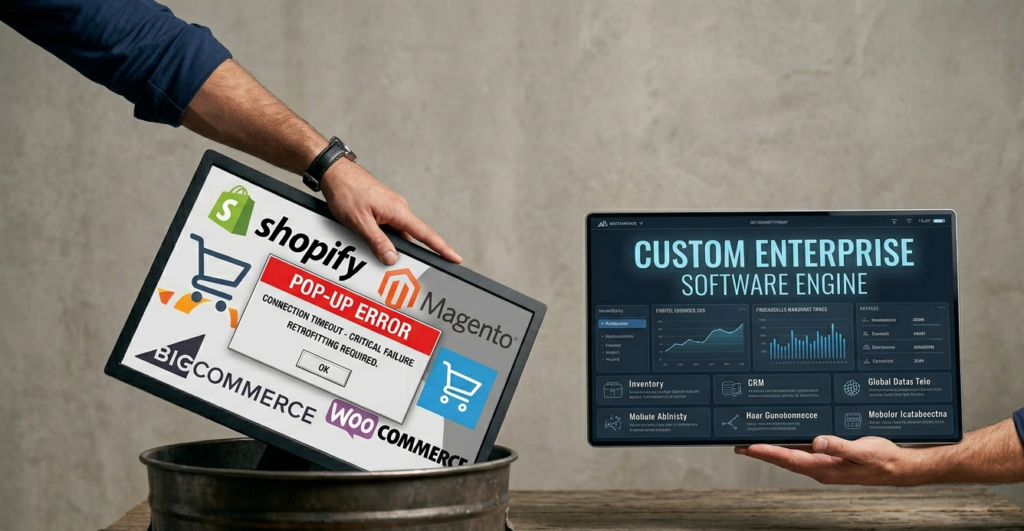
Most ecommerce businesses start on a platform. Shopify, Magento, WooCommerce, BigCommerce. These platforms work well for standard retail operations, and for many businesses they are the right long-term choice. But as organizations scale, the gaps between what the platform does and what the business needs become increasingly expensive.
This article is for operations and technology leaders at mid-size and enterprise retail organizations who are evaluating whether their current ecommerce platform is still the right foundation, and what custom ecommerce solutions actually deliver that platforms cannot.
When Platform Limitations Become Business Problems
Ecommerce platforms impose constraints. They have opinions about how products should be structured, how checkout should work, how inventory should be managed, and how data should flow. For standard retail operations, these opinions align closely enough with business needs that the constraints are manageable.
As operations scale and become more complex, the constraints start costing money. Custom pricing rules that the platform cannot support without expensive third-party apps. B2B workflows that consumer-oriented platforms were not designed to handle. Integration requirements with ERP, WMS, and CRM systems that produce data inconsistencies because the platform data model does not map cleanly to the operational systems.
The platform customization that started as a modest investment grows incrementally until the organization is maintaining a complex stack of apps, plugins, and custom modifications that interact unpredictably and require constant maintenance. At that point, the platform is no longer simplifying ecommerce. It is adding complexity.
What Custom Ecommerce Solutions Actually Deliver
Workflows Built for How Your Business Actually Operates
Custom ecommerce software is built around your specific product structures, pricing rules, customer types, and fulfillment workflows. Instead of adapting your processes to fit a platform, the software fits your processes. For B2B ecommerce, where customer-specific pricing, approval workflows, and account management requirements are common, this flexibility often makes the difference between a functional system and a constant workaround. Our ecommerce software development work addresses these complexities directly.
Clean Integration with Operational Systems
Custom ecommerce solutions integrate directly with your ERP, WMS, and CRM systems through purpose-built integrations that map your ecommerce data model to your operational systems accurately. Instead of managing data inconsistencies between a platform data model and your operational systems, data flows correctly in both directions.
Performance at Scale
Ecommerce platforms are designed for broad compatibility, not optimal performance in your specific environment. Custom solutions can be optimized for your product catalog size, your traffic patterns, and your infrastructure requirements in ways that platforms cannot.
Total Cost of Ownership Over Time
Platform licensing, app subscriptions, customization costs, and the developer time required to maintain a heavily modified platform stack add up over time. Custom solutions have higher upfront costs but lower ongoing costs as the system matures. For organizations planning to operate at scale for five or more years, the TCO analysis often favors custom development.
When to Stay on a Platform vs Build Custom
Custom ecommerce development is not the right answer for every situation. For standard retail operations with moderate catalog complexity, reasonable customization requirements, and straightforward fulfillment workflows, a well-configured platform remains the most cost-effective choice.
Custom development makes sense when your product or pricing complexity exceeds what platforms handle cleanly, when B2B workflows require capabilities that consumer platforms were not designed for, when integration requirements with operational systems produce persistent data quality problems, or when the cumulative cost of platform customization has grown to the point where a custom system would cost less over a five-year horizon.
Software development consulting at the evaluation stage helps organizations make this decision with clear visibility into the real costs of both paths over a realistic time horizon, not just the upfront comparison.
FAQs
Ecommerce solutions for enterprise businesses range from configured platforms like Shopify Plus and Magento Enterprise to fully custom ecommerce systems built to fit specific operational requirements. The right choice depends on the complexity of the business, the integration requirements with operational systems, and the degree to which standard platform capabilities fit actual workflows.
When platform customization costs are growing faster than the business, when integration with operational systems produces persistent data quality issues, when B2B workflows require capabilities the platform cannot support cleanly, or when a five-year TCO analysis shows custom development is more cost-effective than continuing to extend a platform.
Custom ecommerce software integrates with ERP and WMS systems through purpose-built API integrations that map data between systems accurately. Unlike platform integrations that work within the platform data model constraints, custom integrations are built to match the specific data structures of both the ecommerce system and the operational systems it connects to.
Custom ecommerce development for a mid-size to enterprise operation typically takes between 6 and 12 months depending on complexity, integration requirements, and the scope of features required at launch. A phased approach that delivers core functionality first and adds complexity in subsequent phases reduces time to value.
Custom ecommerce software development typically starts at CA$50,000 for focused projects and scales significantly for complex multi-channel platforms with deep ERP and WMS integration. The investment should be evaluated against the ongoing cost of platform licensing, customization, and app subscriptions over a five-year horizon.