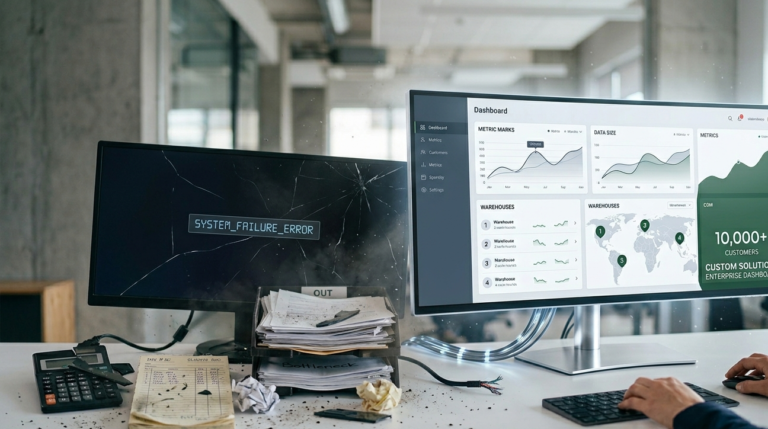
Every growing business reaches a point where the technology it started with stops serving it well. The accounting software that worked for a ten-person company creates bottlenecks for a hundred-person operation. The spreadsheet that tracked inventory for one warehouse does not work across four. The CRM that managed a hundred customers struggles with ten thousand.
Generic technology is designed for the median business. As your business grows and becomes more specific, the gap between what generic tools do and what your business needs widens. Custom IT solutions close that gap. This article explains when generic technology is no longer serving your organization and what custom IT actually involves.
The Pattern of Generic Technology Failure in Growing Organizations
The failure is rarely sudden. Generic technology fails gradually, in a pattern that is recognizable once you know what to look for.
First, the workarounds. The tool does not quite do what you need, so teams develop workarounds. A spreadsheet that supplements the CRM. A manual export-import process that bridges two systems that do not connect. A reporting process where someone compiles data from three sources every Monday morning.
Second, the accumulation. Each workaround seems small. Together they represent significant overhead. Collectively they introduce inconsistency, error risk, and delay that grows with the business.
Third, the breaking point. A new client volume, a new operational requirement, or a critical error reveals that the technology stack is actively limiting the business. By this point, the cost of not having custom IT solutions is often larger than the cost of building them would have been years earlier.
What Custom IT Solutions Actually Cover
Custom Business Applications
Custom software development for internal operations covers the full range of business applications that are specific to how your organization works. Procurement systems, inventory management, project tracking, compliance documentation, workflow automation. These are not off-the-shelf products. They are built around your specific processes and owned by your organization.
System Integration
Most growing organizations accumulate specialized tools that do not share data with each other. Custom API integration connects existing systems so that data flows automatically between them. Instead of manually transferring data between platforms or maintaining inconsistent parallel records, connected systems share a single source of truth.
Custom Reporting and Analytics
Generic reporting tools produce generic reports. When your business has specific metrics that determine operational performance, custom reporting platforms built on your data deliver the visibility that generic dashboards cannot provide.
Mobile Solutions for Field Operations
Mobile app development extends business systems to field teams, remote workers, and operational staff who need access to real-time information and the ability to capture data where the work happens, not back at a desk.
Industries Where Custom IT Delivers the Clearest ROI
Construction firms that manage multiple active projects benefit significantly from custom project management, estimating, and compliance documentation systems. The complexity of construction operations, with multiple subcontractors, regulatory requirements, and real-time cost tracking needs, quickly exceeds what generic project management tools can handle.
Manufacturing operations with specific production workflows, quality control requirements, and supply chain complexity often find that generic ERP systems require so much customization to fit their operations that a purpose-built system would cost less over a five-year horizon.
Logistics companies managing complex carrier networks, multi-modal operations, and real-time tracking requirements quickly outgrow generic TMS platforms designed for simpler operations.
How to Know When Your Business Is Ready for Custom IT Solutions
The signals are usually visible before organizations act on them. Staff are spending significant time on manual processes that connect systems that should connect automatically. Reporting requires someone to compile data from multiple sources regularly. Key business decisions are delayed because the information needed to make them is not available in real time. New operational requirements cannot be met by current tools without significant workarounds.
A software development consulting engagement helps organizations assess honestly where generic technology is limiting operations and where custom IT solutions would deliver measurable ROI. The assessment covers not just the technology gap but the business impact of closing it.
According to Deloitte’s Technology in the Mid-Market Report, mid-market organizations that invest in purpose-built technology see productivity gains significantly above industry averages compared to those relying on generic tools adapted to their specific needs.
FAQs
Custom IT solutions are software systems and integrations built specifically for an organization’s operational requirements, rather than configured from generic off-the-shelf products. They include custom applications, system integrations, mobile solutions, and reporting platforms that are owned by the organization and built to fit its specific workflows.
The clearest signals are significant manual overhead connecting systems that should connect automatically, reporting that requires manual data compilation, operational decisions delayed by lack of real-time information, and new requirements that existing tools cannot meet without significant workarounds. If multiple of these are true, the cost of custom IT solutions is likely lower than the ongoing cost of the current situation.
Enterprise software products are built for a general market and configured to fit specific organizations. Custom IT solutions are built from scratch around the specific requirements of one organization. The trade-off is higher upfront cost for better long-term fit, flexibility, and lower ongoing customization costs.
Focused custom applications typically take 3 to 6 months. Complex multi-system platforms take 9 to 18 months. A phased approach that delivers the highest-priority capabilities first allows organizations to realize value before the full system is complete.
Custom IT projects for mid-size organizations typically start at CA$50,000 for focused applications and scale based on complexity and integration requirements. The investment should be evaluated against the total cost of the current situation, including manual overhead, error costs, and the business opportunities being missed because of technology limitations.