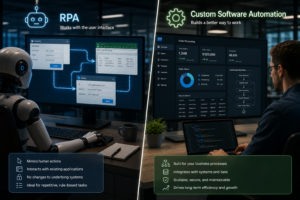
Companies are starting to understand how custom software development can benefit their organizations. While off the shelf software works in some situations, it has many flaws. Primarily, it forces businesses to work and function in a way foreign to them. Processes and procedures that might work in one company are simply unsuitable to others.
However, companies that embrace bespoke software services can change this. By creating software built around actual business processes, companies are more efficient. Legacy applications can also be integrated, ensuring information is not lost.
Creating that perfect application is not easy. This is where User Experience (UX) and User Interface (UI) come into play. It is important to realize that while UI and usability, in general, plays a role in UX, it is only a part of the whole. UX design is larger in scope and needs to include the full life cycle of the product.
Usability Plays a Key Role in the User Experience
When discussing software, UX design is somewhat different. Here, a UX designer acts as the customer advocate within the business. Their focus needs to be on ensuring the customer’s needs are being considered at all stages, with usability being a key role.
Usability is a measurement of how easy a product or service is for consumers. Does it achieve its objectives and does it do so efficiently and effectively? Most importantly, is the user satisfied with it? Usability matters greatly. Customers that are unable to use a product in the manner they expect, are unlikely to continue utilizing it in the future.
Information Architecture Process and Creating the Best UX
The internet has almost anything you want. All the information and knowledge we have managed to compile as a species is available – if you can find it. Sadly, while the information is there, often the result of the best searches will only turn up another cat video. Fortunately, a new role has come into existence to solve this problem.
Information architecture (IA) is built around structuring and organizing the information online. Whether that information is contained on social media sites, blogs, websites or mobile applications, IA helps to organize and make the information usable.
Information architecture also has a UX component. While organizing information is useful, it does not really solve the problem. UX ensures that the content is organized in a manner such that it is favorable to the actual user. This is done by researching the actual target audience and then building an appropriate structure.

The Difference Between UX and UI Design
UX and UI are often combined in people’s minds. While they are related, they are also very distinct and separate disciplines and skills.
UX, in a nutshell, is focused on the user experience and how usable the application is. UX considers what the user wanted and how close the design is to that need. It looks at how easy or difficult an application is to use.
UI, by contrast, is about the look and feel of the application. It still considers usability, but now looks at it from the point of view of the graphics. This includes things like icons, buttons, colors, and fonts.
Software Development Services that Bring UX and UI Together
Custom software solutions needs to consider both UX and UI. It is important to know what the client needs and wants. What are they trying to achieve and who their end customers are, all play a part in the UX conversations. Added to this is a requirement of understanding the technologies needed. For example, smartphone apps can be built that function on either iOS or Android.
If a company needs to use both technologies, different programming languages and tools will be needed.
Once these decisions are made, UI helps determine the overall look and feel of the application. By pairing the two together, a powerful, user-friendly application can be built. Discounting either of the two, however, is a recipe for failure.

Custom Software Development
Konverge understands the importance of UX/UI design. With the power of the customer growing daily, Konverge knows any missteps can have severe consequences. Companies need to realize that consumers are no longer restricted to their local market when making a purchasing decision.
Consumers now have access to the entire world for information, tools, and products. Services that are not exactly to customer requirements or needs are unlikely to retain consumers. Added to this is the potential for negative consequences through social media commentary, and the importance of UX/UI becomes even greater.
Konverge knows how to build apps for all of the different operating systems and has teams of developers available. With our skilled team of project managers, designers, engineers, and architects, we can take your idea from a blue sky dream to real-world reality. Contact us for more information and to find out how we can help.
FAQs
UX (User Experience) and UI (User Interface) design are essential in custom software because they determine how users interact with the system and how easily they can achieve their goals. Strong UX/UI design for custom software ensures that applications are intuitive, efficient, and visually appealing. UX focuses on usability, structure, and flow, while UI focuses on visual elements like layout, colors, and typography. When combined effectively, they create software that not only functions well but also delivers a seamless and engaging user experience that improves adoption and productivity.
UX design improves custom software usability by studying user behavior and designing systems that reduce friction during interaction. It ensures that workflows are logical, navigation is simple, and tasks can be completed with minimal effort. Through user research, journey mapping, and usability testing, designers identify pain points and eliminate unnecessary complexity. This leads to software that is easier to learn and use, reducing training time and increasing efficiency for both employees and end users.
UI design plays a critical role in shaping the visual identity and usability of business software. A well-designed interface improves clarity, consistency, and accessibility, making it easier for users to interact with the system. In enterprise UI design, elements such as buttons, icons, spacing, and color schemes are carefully chosen to enhance readability and reduce confusion. Good UI design also builds trust, as users tend to perceive visually polished software as more reliable and professional.
The difference between UX and UI design lies in their focus areas. UX design is about the overall experience, including how users navigate the software and complete tasks. UI design, on the other hand, focuses on the look and feel of the product, including visual components and interactive elements. UX ensures the product is functional and user-friendly, while UI ensures it is visually appealing and consistent. Both are essential for building successful custom software solutions.
Improving UX/UI design in business software directly impacts productivity, user satisfaction, and operational efficiency. Well-designed systems reduce errors, speed up task completion, and lower training costs. They also increase employee engagement and reduce frustration when working with complex systems. For customer-facing applications, better UX/UI can lead to higher conversion rates, improved retention, and stronger brand loyalty, making it a key investment for long-term business success.
Effective UX/UI design principles include simplicity, consistency, accessibility, responsiveness, and user-centered design. Simplicity ensures that users are not overwhelmed with unnecessary features. Consistency helps users understand patterns and navigate easily. Accessibility ensures that software can be used by people with different abilities. Responsiveness guarantees smooth performance across devices. Together, these principles create a cohesive and efficient digital experience that aligns with user expectations.
Businesses measure UX/UI design success using metrics like user engagement, task completion rates, error rates, and customer satisfaction scores. Tools like heatmaps, session recordings, and user feedback surveys help identify how users interact with the system. A decrease in support requests and an increase in productivity are also strong indicators of successful design. Continuous testing and iteration ensure that UX/UI remains aligned with evolving user needs and business goals.