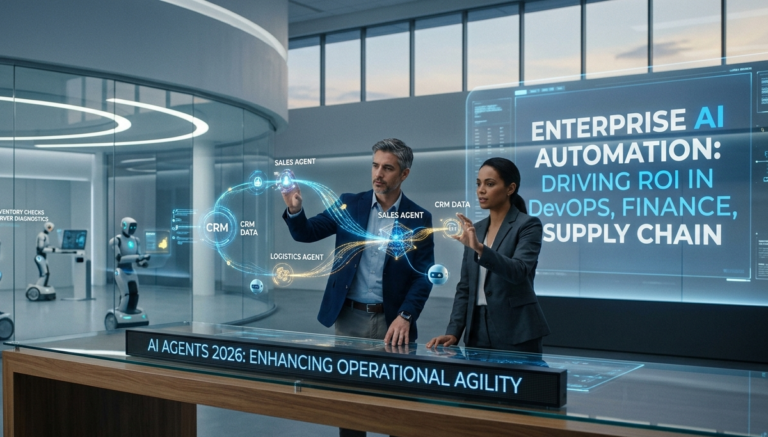
The Rise of Enterprise AI Agents in 2026
AI is no longer an experimental tool inside businesses. In 2026, it has become a core operational layer for large organizations across manufacturing, retail, logistics, and professional services. AI agents are now handling workflows that previously required entire teams.
Traditional enterprise software was built to store information and generate static reports. It was not designed to interpret intent or take action. This limitation created a gap between data and decision-making. Business leaders often rely on delayed reports and manual analysis before making critical decisions.
AI agents close this gap. They operate as intelligent digital operators that can understand business questions, analyze connected systems, and execute tasks based on defined goals. Instead of simply showing data, they actively work with it.
A business can now ask complex operational questions in plain language. For example, it can request a breakdown of procurement spending, material waste, and margin impact across time periods. AI agents gather information from multiple systems and produce immediate answers.
What AI Agents Are and How They Differ from Traditional Automation
Most organizations already use automation in finance, HR, and operations. However, traditional automation relies on fixed rules. It only works when conditions are predefined.
AI agents operate differently. They interpret context, evaluate multiple data sources, and determine the most suitable action based on objectives.
In a retail environment, traditional automation might trigger a reorder when inventory falls below a fixed number. An AI agent evaluates additional factors such as sales velocity, seasonal demand, supplier reliability, and regional trends before making a decision. It can choose whether to reorder, redistribute stock, or delay procurement.
AI agents also operate across multiple systems instead of being restricted to one platform. They can interact with customer systems, financial tools, internal databases, and communication channels simultaneously. This removes the separation between departments and allows workflows to move across the entire organization.
Over time, AI agents improve through continuous exposure to historical patterns. They identify recurring issues such as supplier delays or billing inconsistencies and adjust future recommendations accordingly.
Why 2026 Became the Breakthrough Year for Autonomous Operations
The year 2026 marked a turning point because major technology providers shifted from conversational AI to operational AI systems.
- OpenAI expanded enterprise capabilities by enabling AI systems to connect directly with business tools such as customer management systems, finance platforms, and internal dashboards. This allowed organizations to move beyond chat based assistance into full operational support.
- Anthropic advanced long context reasoning, which allowed AI systems to analyze large volumes of enterprise documentation. Businesses began using these systems to review contracts, identify cost changes, and detect compliance risks without manual effort.
- Microsoft accelerated adoption through deep integration of AI systems into enterprise products such as Copilot, Dynamics, and Azure services. This made it possible for companies already using Microsoft infrastructure to deploy AI agents without rebuilding their technology stack.
- Google also expanded enterprise automation through Gemini based systems integrated into workplace tools and cloud services. This enabled companies to automate reporting, analysis, and workflow coordination within familiar environments.
- At the same time, business demand increased significantly. Leaders wanted immediate answers instead of dashboards. The ability to ask direct questions and receive operational guidance changed expectations at the executive level.
Challenges in Deploying AI Agents
Despite rapid adoption, organizations face several challenges when implementing AI agents.
- Data fragmentation remains a major issue. Many businesses store information across disconnected systems, which limits effectiveness.
- Governance is another concern. Since AI agents can execute actions, organizations must establish strict control frameworks to prevent unintended outcomes.
- Accuracy and reliability also require attention. AI systems may produce incorrect outputs when data is incomplete or inconsistent, making validation layers essential.
- Finally, organizational change is significant. Employees must shift from task execution roles to system supervision roles, requiring training and adaptation.
The Role of Custom Software Development in AI Agent Adoption
The best way to bring a business up to speed with AI integration is through custom software development. AI agents alone are not enough if the underlying systems are not designed to support them. The real value comes when AI is built directly into software that is tailored to how the business actually operates.
Many organizations try to plug AI into existing tools, but this creates limitations. Off the shelf software is built for general use cases, not for the specific workflows of a growing organization. AI cannot fix structural gaps in poorly designed systems. It can only work with the data and processes it is given.
This is why custom software becomes essential. When a business builds its own system around its operations and integrates AI into it, the software evolves alongside the organization. It becomes a living system that adapts as processes, teams, and goals change.
A customized platform allows AI agents to be embedded directly into core workflows such as finance, supply chain, customer management, and reporting. Instead of acting as an external tool, AI becomes part of the operational structure.
This approach also ensures long-term scalability. As the business grows, new features, data sources, and workflows can be added without breaking existing systems. AI agents continue learning within the same environment, improving performance over time.
In practice, this is not just an upgrade. A one time foundational investment aligns technology with the long-term direction of the organization.
The Future of AI Agent Led Enterprises
The future enterprise model will be structured around networks of AI agents managing core business functions. Instead of employees navigating multiple systems, AI agents will coordinate operations across departments.
Each business function will likely have dedicated AI agents responsible for continuous optimization. These agents will interact with each other to balance priorities such as cost efficiency, customer satisfaction, and operational speed.
Over time, businesses will shift from manual management structures to autonomous operational environments. Human roles will focus more on strategy, oversight, and exception handling.
Conclusion
AI agents in 2026 represent a fundamental shift in how enterprises operate. They are no longer experimental technologies but core components of business infrastructure.
When combined with custom software development, AI agents become deeply integrated operational systems capable of coordinating data, workflows, and decisions across entire organizations.
Businesses that adopt this model early gain advantages in speed, efficiency, and visibility. The shift is not simply about automation. It is about building intelligent systems that continuously adapt and improve how businesses run.
FAQs
AI agents in 2026 work by connecting to multiple business systems, analyzing live and historical data, understanding intent from natural language inputs, and executing actions within defined rules. They operate across tools like CRM, ERP, finance platforms, and internal databases to provide real time insights and automation.
AI agents are used for supply chain optimization, financial forecasting, customer support automation, HR workflows, IT monitoring, and cross system decision making.
Traditional automation follows static rules and triggers. AI agents evaluate context, compare multiple data points, and decide the best action based on business objectives rather than fixed conditions.
They reduce manual decision-making delays, improve operational visibility, and allow businesses to respond to changes in real time instead of relying on periodic reports.
Custom software aligns AI agents with a company’s specific workflows and systems, allowing deeper integration, better data flow, and long-term scalability across evolving business needs.