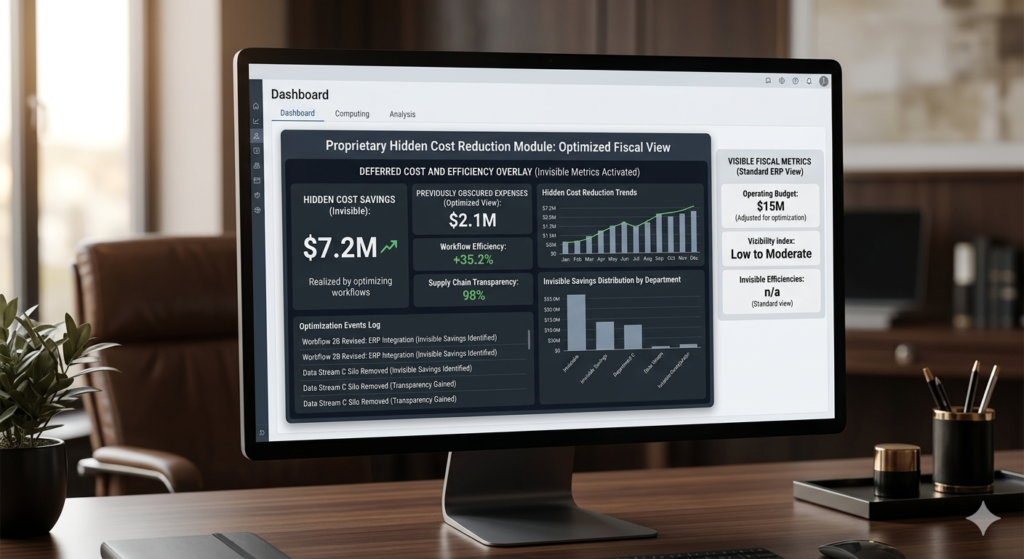
Every large firm faces costs that never appear in a budget line but still drain profitability: manual work that slows teams down, errors that require rework, disconnected systems that waste time, and reporting delays that lead to poor decisions. Enterprise Resource Planning (ERP) automation cuts through these hidden operational costs by uniting your business on a single platform and automating core processes.
What is Enterprise Resource Planning(ERP)
Enterprise Resource Planning, commonly called ERP, is a centralized software system that connects disparate functions across an organization. Instead of separate tools for finance, procurement, inventory, sales, HR, and compliance, you get one shared system with real‑time data.
Think of your firm like a complex machine. If each department runs on its own clock and separate fuel source, the machine sputters and wastes energy. An ERP system synchronizes every part so your organization runs more smoothly with less friction.
This is why enterprise application development has become essential for large firms that need connected processes and real‑time visibility.
What ERP Does
At its core, ERP automates and integrates:
- Data entry and validation
- Workflow approvals and task routing
- Inventory monitoring and replenishment triggers
- Sales order fulfillment and billing
- Financial consolidation and compliance reporting
- Real‑time dashboards and performance tracking
Instead of people manually exporting spreadsheets reconciling accounts and chasing approvals, ERP automates these behind the scenes. Staff spend time on critical thinking and strategy rather than repetitive tasks.
Hidden Operational Costs Firms Commonly Miss
When processes are manual and systems are disconnected, costs hide in plain sight:
- Duplicate work where several teams rekey the same data
- Hours lost waiting for reports or approvals
- Errors and rework from inconsistent information
- Inventory waste due to overstocks, stockouts, or miscounts
- Compliance risk from outdated or inconsistent records
- Delayed decisions from stale or fragmented data
For example, a manufacturing firm might track inventory in separate spreadsheets across sites. Without real‑time visibility, the purchasing team buys excess stock to avoid shortages. This ties up capital and space. An ERP system prevents this by showing precise inventory levels and demand forecasts in real time.
In another casea services company without centralized project tracking discovered multiple departments were billing the same customer for overlapping work, because there was no unified process. Automated ERP workflows would stop this issue by routing hours and billing approvals through a single system.
These hidden costs rarely erupt in a crisis but quietly erode margins over time. They are the reason executives often feel internal operations are “slow” without knowing exactly why.
How ERP Tackles Hidden Costs
Real‑Time Data Flow
Unified systems eliminate manual reconciliation. When sales generate an order, inventory and finance update instantly. No waiting, no email chains, no errors.
Process Automation
Approvals for purchasing, contract renewals, billing, and compliance checks happen automatically according to business rules you define. This cuts labor hours and reduces errors.
Central Dashboards and Insights
Leadership gets up‑to‑the‑minute visibility into operations. You can see bottlenecks before they disrupt production or cash flow.
These improvements aren’t theoretical. Many enterprise software initiatives we see during software product development engagements begin by uncovering time and costs that were previously invisible. When processes become automated, the savings are immediate because teams are no longer working on low‑value manual tasks.
How Not Having ERP Hurts Your Firm
Operating without ERP in a large organization is like driving a luxury car and never checking the dashboard. You may think everything is fine until the engine overheats.
Without ERP:
- Manual work becomes a hidden workforce cost
- Departments operate in silos
- Reporting lags behind actual events
- Strategic decisions are made on outdated or incomplete information
- Compliance and audit readiness become expensive pain points
For example, a distribution company that manually tracked regulatory stamps risked fines and lost hours reconciling records across teams. Once automated through a centralized system, compliance became a by‑product of normal operations rather than a separate costly task.
Cost Benefit and the Hard Numbers
Large firms often hesitate because ERP involves investment. But the returns are measurable:
Tangible Cost Savings
Reduced labor for reconciliation and reporting, lower inventory carrying costs, fewer errors that require remediation, and faster cycle times.
Intangible Gains
Better decision making, improved customer experience, and employees focused on strategic goals rather than routine tasks.
Change Management
There is work to train teams and align processes. But when ERP replaces manual and disconnected systems the result is smoother operations and less friction between teams.
Why Custom ERP Fits Your Firm Better
Standard ERP packages may solve broad problems, but large organizations often face unique workflows that generic tools cannot handle without costly add‑ons.
A tailored solution created by a custom software development firm provides:
- Exact alignment with your business processes
- Elimination of unnecessary features that clutter user experience
- Integration with legacy systems without forcing replacements
- Flexibility to evolve as your firm grows
Choosing a software development company Canada for your enterprise solution ensures you get software built around your real needs, not a one‑size‑fits‑all product.
Just as a bespoke vehicle tuned to your driving style performs better than a factory model, enterprise application development tailored to your firm delivers higher operational efficiency and greater ROI.
Conclusion
ERP automation is a strategic investment that makes hidden operational costs visible and manageable. By integrating data and automating workflows it eliminates inefficiencies that large firms absorb every day without realizing the impact. While standard ERP systems offer value, a customized solution from a trusted software development company Canada or software product development company delivers unmatched alignment with your operations and lasting savings.
Firms that embrace custom ERP not only cut hidden operational costs but also build a flexible platform for future growth and competitiveness.
FAQs
ERP automation means using one connected software system to run everyday business processes without relying heavily on manual work. It handles tasks such as data entry, approvals, reporting, inventory updates, and billing in an automated way. Instead of employees repeating the same actions across multiple tools, everything flows through a single system. This reduces effort, improves accuracy, and speeds up operations across departments.
ERP reduces hidden operational costs by removing inefficiencies that are often not tracked directly in budgets. These include duplicate work, manual reporting, delayed approvals, and poor communication between teams. When processes are automated and integrated, employees spend less time on repetitive tasks and more time on meaningful work. This leads to lower operational waste, fewer errors, and better use of resources across the business.
Hidden costs often appear as small inefficiencies that build up over time. Examples include employees entering the same data into different systems, delays caused by waiting for approvals, and errors that require rework. Inventory issues such as overstocking or stock shortages are also common. These problems do not always show up as direct expenses but they steadily reduce profitability and slow down overall performance.
ERP systems are most effective for medium and large organizations that manage multiple departments, processes, or locations. Smaller businesses can also benefit, especially if they are growing quickly or facing operational complexity. The key is choosing the right solution size. Some businesses may only need a simple cloud-based ERP, while larger enterprises often require more advanced and customized systems that match their workflows.
Standard ERP systems come with fixed features designed to fit a wide range of industries. They are faster to implement but may not fully align with specific business processes. Custom ERP solutions are built around a company’s exact requirements, including workflows, integrations, and reporting needs. While custom systems take more time to develop, they usually provide better efficiency, scalability, and long-term value because they fit the business instead of forcing the business to adapt.