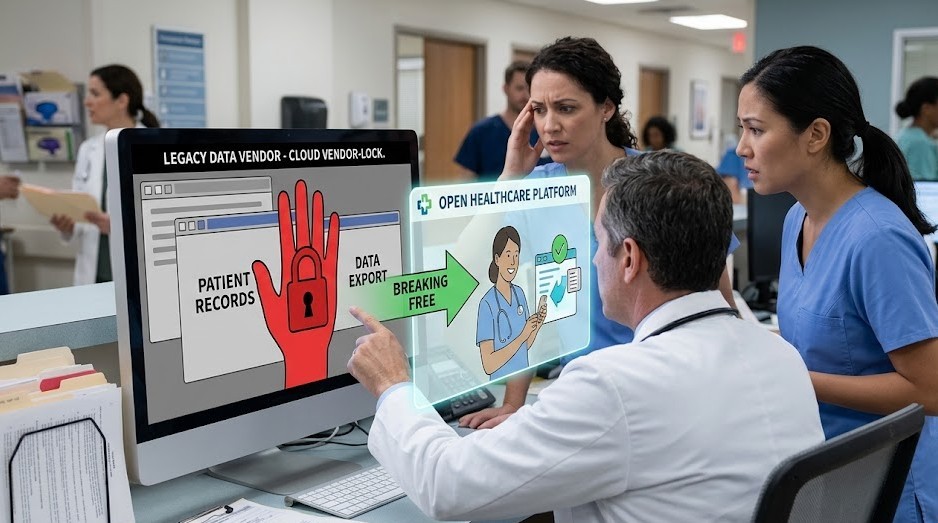
Understanding the Real Problem Behind Legacy Healthcare Data Vendors
Most healthcare organizations do not struggle because they lack software. They struggle because they are trapped inside software ecosystems that were never designed to evolve with them. Legacy healthcare data vendors often provide monolithic systems that bundle storage, workflows, reporting, and integrations into tightly controlled environments. On the surface, this looks convenient. In reality, it creates long-term dependency that limits innovation and slows down operational agility.
The deeper issue is not just outdated technology. It is the lack of flexibility to adapt clinical and operational data to new business needs. Healthcare providers today need systems that support interoperability, real time analytics, cloud scalability, and integration with modern medical data platforms. Legacy vendors often cannot deliver this without costly upgrades or restrictive contracts.
This is where healthcare organizations begin to feel the friction. Data becomes difficult to access, workflows become rigid, and integrating new digital health tools becomes slow and expensive. At this point, the conversation shifts from system maintenance to healthcare data migration and custom software development. The real opportunity is not just replacing systems, but building a tailored ecosystem through custom healthcare software solutions that align with clinical and business goals.
For B2B healthcare organizations, including hospital networks, diagnostics providers, and healthtech companies, the ability to control data architecture is a strategic advantage. Custom solutions allow them to design workflows, data models, and integrations around their actual operations rather than forcing operations to fit vendor constraints.
Why Legacy Healthcare Systems Block Business Growth
Legacy healthcare systems continue to dominate because they were designed for stability, not adaptability. However, modern healthcare businesses operate in a completely different environment. They require fast integration with third party systems, real time reporting, interoperability with external providers, and seamless patient data exchange.
The biggest limitation of legacy systems is their closed architecture. Many do not support modern APIs or require expensive middleware for integration. This creates bottlenecks when organizations try to implement healthcare interoperability solutions or connect with external analytics platforms.
From a business perspective, this directly impacts scalability. A healthcare organization cannot expand services, launch digital health products, or improve patient engagement if its core data infrastructure is locked in rigid systems. This is where custom software development becomes essential. Instead of relying on vendor limitations, organizations can build modular systems that evolve with their operational needs.
There is also a significant cost inefficiency. Vendors often charge for every customization, integration, or upgrade. Over time, these incremental costs exceed the investment required for a fully customized healthcare data migration strategy supported by tailored software architecture.
For B2B healthcare leaders, the real question is not whether to modernize, but how to transition without disrupting clinical operations. That is where structured migration combined with custom-built platforms becomes a competitive advantage.
Healthcare Data Migration as a Strategic Business Transformation
Healthcare data migration is often misunderstood as a technical process of moving records from one system to another. In reality, it is a full scale business transformation initiative. It involves rethinking how data flows across clinical, operational, and administrative systems.
When executed properly, healthcare data migration becomes the foundation for building custom healthcare software ecosystems. Instead of simply transferring data, organizations redesign how data is structured, accessed, and used across departments.
A modern approach to data migration in healthcare industry environments focuses on three core objectives. First, preserving clinical accuracy and data integrity. Second, enabling interoperability across systems. Third, creating a flexible data foundation that supports future custom application development.
This is where healthcare organizations increasingly rely on healthcare data migration services that specialize in custom solutions rather than generic migrations. These providers do not just move data. They engineer transformation pipelines that align with business logic, compliance requirements, and long term scalability goals.
Custom migration strategies also allow organizations to integrate analytics, AI, and automation directly into their data architecture. This is not possible with rigid legacy systems that limit data accessibility.
Why custom software changes the migration equation
Traditional migration focuses on replication. Custom migration focuses on optimization. Instead of simply recreating old systems in new environments, custom software solutions allow organizations to redesign workflows entirely.
For example, during EMR migration or EHR migration projects, custom platforms can restructure patient data models to support real time decision making. They can also integrate with external systems such as laboratories, insurance providers, and remote monitoring devices without additional vendor dependencies.
This approach transforms migration from a cost center into a strategic investment. It also reduces long-term reliance on third party vendors, giving healthcare organizations full ownership of their digital infrastructure.
Building Interoperable Healthcare Systems with Custom Software
Interoperability is one of the biggest challenges in healthcare technology. Legacy systems were not designed to communicate with each other efficiently. As a result, healthcare organizations often rely on manual processes, duplicate data entry, or expensive integration layers.
Custom software development solves this problem at its core by designing systems that are interoperability first. Instead of forcing data to fit into predefined structures, custom healthcare platforms are built around open standards such as FHIR and HL7, while also supporting enterprise specific extensions.
This is especially important for organizations managing multiple data sources such as EMR systems, imaging platforms, and patient monitoring tools. With custom healthcare data integration solutions, all these systems can be unified into a single operational layer.
From a B2B perspective, this creates significant competitive advantages. Healthcare providers can launch new digital services faster, improve patient engagement, and enhance operational efficiency without waiting for vendor updates.
The role of healthcare data platforms in modern architecture
Modern healthcare data platforms are no longer static repositories. They are dynamic ecosystems that support real time data processing, analytics, and application development.
Custom-built platforms allow organizations to define their own data models, access rules, and integration frameworks. This flexibility is critical for scaling operations across multiple facilities or geographic regions.
It also enables advanced use cases such as predictive analytics, population health management, and AI driven diagnostics. These capabilities are extremely difficult to achieve with legacy healthcare systems that restrict data access or lack modern APIs.
Designing a Custom Healthcare Data Migration Strategy
A successful migration strategy for healthcare organizations is not just about tools. It is about architecture, governance, and long term scalability. Custom healthcare data migration strategies begin with a deep assessment of existing systems and business requirements.
Instead of focusing only on technical extraction, organizations evaluate how data is used across clinical workflows. This includes understanding dependencies between systems, identifying data quality issues, and mapping future state requirements.
Once this foundation is established, custom migration pipelines are designed to support phased transitions. This ensures that clinical operations continue without interruption while data is progressively moved into new environments.
In B2B healthcare environments, this approach is particularly important because downtime directly impacts revenue, patient care, and compliance risk.
Importance of data conversion and transformation layers
Data conversion plays a critical role in custom migration strategies. Legacy systems often store data in inconsistent or proprietary formats. Custom data conversion layers ensure that this information is standardized and compatible with modern systems.
This includes emr data conversion, ehr data conversion, and normalization of clinical datasets across multiple sources. Advanced transformation logic can also enrich data during migration, improving its usability for analytics and reporting.
Unlike generic tools, custom-built conversion systems are designed around the specific needs of the organization. This ensures higher accuracy, better performance, and long term maintainability.
Why B2B Healthcare Organizations Need Custom Migration Partners
For healthcare enterprises, migration is not just an IT project. It is a business critical transformation. Choosing the right healthcare data migration company is essential, especially one that specializes in custom software solutions rather than one size fits all implementations.
Custom migration partners bring a combination of technical expertise and domain knowledge. They understand clinical workflows, regulatory requirements, and enterprise scale data challenges.
More importantly, they design solutions that go beyond migration. They help organizations build long term digital infrastructure that supports innovation, scalability, and interoperability.
This is particularly important for organizations transitioning from systems like Cerner or other legacy EMR platforms. Without custom engineering, these migrations can become complex, risky, and expensive.
The Business Impact of Moving Beyond Legacy Systems
The shift away from legacy healthcare data vendors is not just a technology upgrade. It is a business transformation that directly impacts efficiency, scalability, and revenue growth.
Organizations that invest in custom healthcare software and structured data migration gain several advantages. They reduce operational costs by eliminating vendor lock in. They improve data accessibility for clinical and business decision making. They also unlock new opportunities for digital health services and AI driven innovation.
Most importantly, they gain control over their own data infrastructure. This allows them to adapt quickly to changing market conditions, regulatory requirements, and patient expectations.
In a competitive healthcare landscape, this level of agility is no longer optional. It is a strategic necessity.
Conclusion
Breaking free from legacy healthcare data vendors requires more than migration. It requires a shift toward custom software development, interoperable systems, and scalable data architecture.
For B2B healthcare organizations, the real opportunity lies in building tailored solutions that combine healthcare data migration with long term digital transformation. Instead of being constrained by vendor limitations, organizations can design systems that reflect their operational reality and future ambitions.
Custom healthcare software does not just replace legacy systems. It redefines how healthcare data is used, shared, and transformed into business value. Check out this for an example of what custom software can do
FAQs
The biggest benefit is control. Organizations gain full ownership of their data, reduce vendor lock in, and unlock the ability to build custom healthcare software that matches their clinical and business workflows.
Custom software allows migration pipelines to be designed around real operational needs instead of rigid vendor structures. This improves data accuracy, enables better interoperability, and supports long term scalability across systems.
It can be risky if done without proper planning. However, with phased migration, validation frameworks, and custom integration layers, organizations can maintain full clinical continuity with minimal disruption.
Interoperability ensures that different systems such as EMRs, labs, imaging platforms, and monitoring tools can exchange data seamlessly. Without it, clinical workflows become fragmented and inefficient.
Custom migration is ideal when systems are highly complex, data is fragmented across multiple platforms, or when long term goals include building scalable digital health products or integrated healthcare data platforms.